Wednesday, February 15, 2012

angles

Finally have a direction with the first two maps...and then we have two more.

The drawdel is a photo collage with significant pieces pulled up and pushed into the page. A perspectagonal photographic pop-up collage. No biggie. I'm using one photograph that specifically depicts the space and extends beyond the edges of the photograph to engulf the page in the space. I unsuccessfully tried working out another way to represent the trees. I'm not a fan of it, so I am trying something else. Just for the record, this is the unloved attempt:


The 3d drawing (the one I was more lost in) is a plan in perspective layered with a perspective layered a third time with significant sections. I'm using different line weights to depict the different layers with a particular emphasis on the section. Because the space I'm mapping reverses the angles of the graves, it is important to depict the vertical, physical, opening up of the space in context with the width of the plan.
-a

Monday, February 13, 2012

already

I absolutely love the spot in Iqualada cemetery where it has a brief moment of openness. When I first looked at it, it was obvious that it was a transition zone, but of what I didn't know.

(Thanks, Panaramio)

PreLuis:
Things like this were happening:


Ok, interesting to some extent. But I hadn't really looked enough at the plan to know much, if anything, about why the space felt the way it did. So, we went on a field trip to the library, and we talked about the plan and the section. Concrete things that actually matter. Luis said something interesting: we are only mapping what is already there, not creating something new. It just won't be as good.

PostLuis:


In the library, books showed that the transition zone was denser with trees. Why did the trees get denser? What were they separating? The public from the private. So, my reversible, etc. map will be a map of the tree cluster that makes a clear division between two halves of the cemetery.

Map two, the drawn map, will examine in a perspectagonal section the openness of the transition zone due to a changed sloped of the graves versus the closed, darker parts of the walk.

I was pretty adamant about not getting stuck in plan due to past studio professors who tried to steer me away from that. However, the only way to know what is happening is to look at what is already there. I am not creating something new out of what is already a metaphorically and physically rich environment. I am just trying to figure out what it means.
-a

accessible

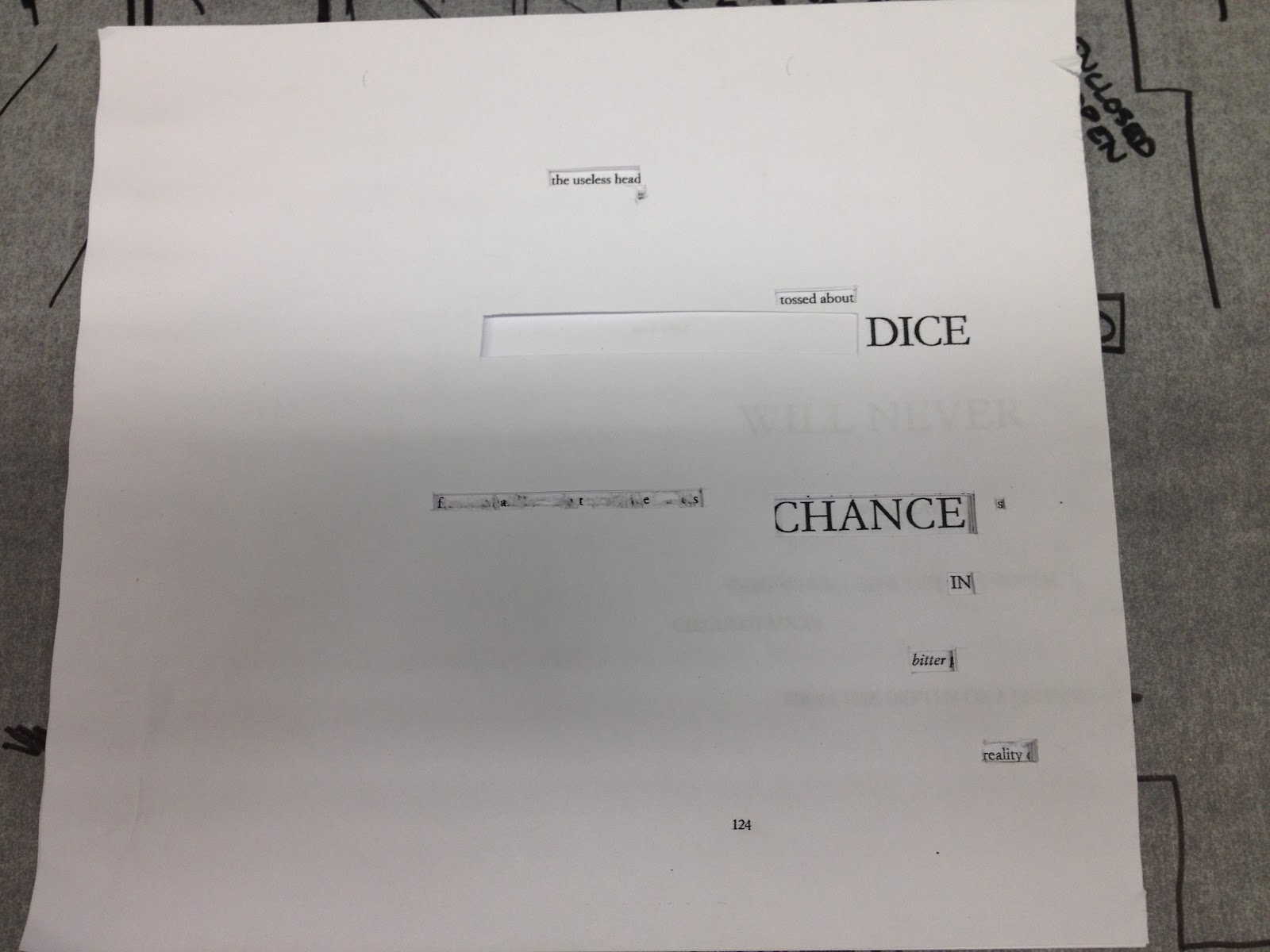
Not going to lie. This poem frustrated me. Mostly because I like to have a right answer, and I could not figure out which way we were supposed to read it.

So, when I got the chance to, I simplified the words to my most basic understanding of the poem.


The poem now reads:
the useless heads
     tossed about DICE
fates CHANCEs in bitter reality

The useless heads                            humans in general, useless because
Tossed about dice                           we have no control over fate
Fates chances in bitter reality            fate can roll the dice (its chances) but they are already chosen
                                                       Therefore: our reality is chosen for us.

To me, it makes more sense. The meaning is more accessible. However, it's just my personal interpretation. I can't say if I like it more or less.
-a

atypical

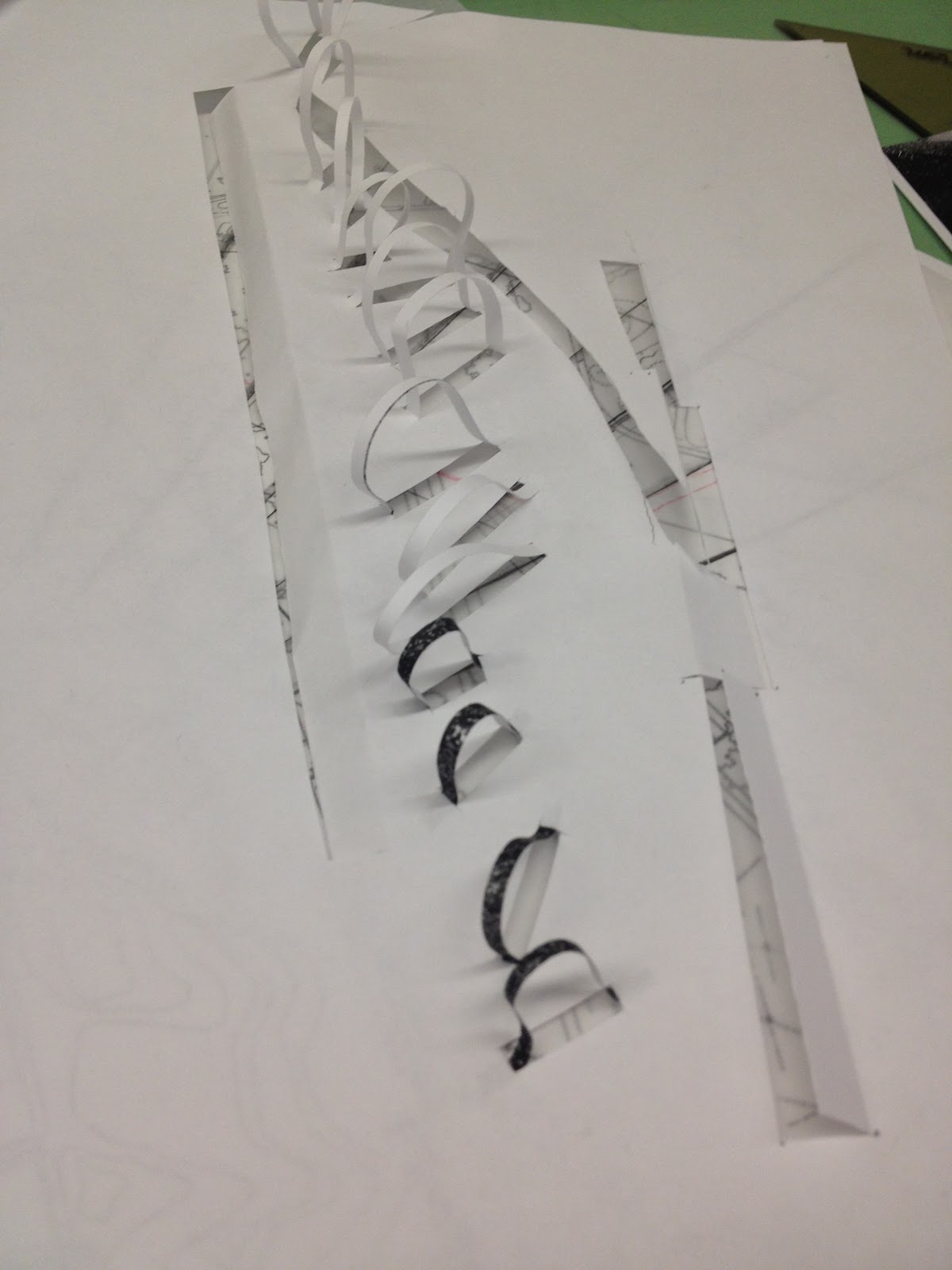
Who knew that cutting into a book would be so ridiculously hard. It's just paper...but mass quantities.

I'm excited about the end result of my book. It was an interesting process to go through, and it was neat to see what everybody else came up with.


The first segment of the book is comprised of the Contents label at the top followed by a collage of psychotherapists found about halfway though the book. Because the book is the history of psychotherapy and therapists, I thought it was important to highlight the actual people rather than going entirely metaphorical for the first third.


The second third of the book consisted of woven strips that gradually (in groups of 3 to represent the Id, the Ego, and the Superego) were removed. The first woven section represents the mind, and every grouping after is representative of psychotherapists helping the individual unravel his inner thoughts.


When flipped, the last page of weaving reveals a small slit, the third and final section. At this point, the psychotherapist has reached the edge of the subconscious. After doing some basic research and talking to a couple of psych majors, I found the subconscious to be infinitely expansive. So:


The back of the book is cut to allow the subconscious to continue out of the book and expand forever.

I enjoyed this project a lot; it gave us the chance to reinterpret something new. By giving us a solid and asking us to carve away at it, we solved the problem in a way that was atypical to the usual. Often times, we find we are given a blank paper or a sheet of cardboard and told to construct something out of nothing. However, we already had something, and we had to deconstruct it to something more. Very clever.
-a

Tuesday, January 31, 2012

adolescent

That's basically what I feel like when it comes to psychotherapy. My book and most of my thoughts since Friday have revolved around a topic I knew and still know very little about. I feel like a second grader in a room full of doctorate holders.

However, that just makes me want to figure it out that much more. Who doesn't love a challenge?

There is absolutely no hope in me becoming the next Freud between now and the due date, but I'm trying regardless to harness a deeper understanding of the world of psychotherapy. I read the introduction to the book (most of which made sense!), and I've talked to as many people as I've run into about psychotherapy in general. I'm lucky; I live with two psych majors who, regardless of whether or not they understand the creativity aspect of the project, are thrilled when I ask questions about psych. I'm sure their teaching style is simplified, but I have to thank them for giving me a more stable foundation to rest my creative ideas on.

So, the ideas are like this:
1) The original idea was sparked by a quote in the book about the conscious versus the *subconscious. In my head, the conscious encompasses everything I am aware of; the sub- is just the opposite. Along this thought process, I created a metaphorical landscape representative of the conscious, the sub-, and the psychotherapist. The conscious is represented by a hill leading to a cliff, where the cliff represents the precipice of the conscious. The sub- is represented by the cavern, which is only visible through a small opening on the top. After speaking with a friend about The Allegory of the Cave, I thought a hidden cavern in the book would be suitable for the hidden and hard to discover sub-. The psychotherapist is represented by light; he holds the ability to explore the sub- through the hole, while the person who is under exploration cannot see into the cavern when standing on the edge of the cliff.

2) Next came the idea of "the royal road to the unconscious" of Freud. For this, I had the idea of wrapping and excavating the book in one continual void. The moments were the void's path is lost in the book would be representative of the unconscious, and the moments of visible void would represent the conscious. The book itself represents the human mind.

3) This is when my suite mates came into play. From them, I learned about the Id, the Ego, and the Superego. Cool, easy enough to represent in book sculpture, right? Wrong. This idea is one that I struggled immensely with until late Monday night (not to say that I've got it all figured out, because I definitely don't). I was trying to think of three distinct ways to represent the levels of the mind.

The first level I see as more self-explanatory and simple, something to be expressed through distinct geometries. I picture some sort of woven pieces that represent the conscious workings of the mind.

The second level is the bridge between the conscious and unconscious. It is represented in similar strips to the conscious, although the strips take on more organic feels and directions. The weaving becomes less strict and the idea of free-form, organic loops is more evident.

The third level is the unconscious. For this, I thought about myself. What is my unconscious? According to some psychotherapists, one needs a psychotherapist to discover the inner workers of the mind. I see my mind as a vast expanse of who knows what. My deepest thoughts, joys, ideas, etc. are all kept in this vast expanse. For this reason, I represent the third level with void.

4) The last idea is the most recent idea. It was sparked by the readings about voids and solids. There is a passage in the reading that talks about the solid being meaningless without the void but the void having meaning without the solid. I found this to be mind boggling, definitely. It's just not something I ever really considered. However, I am liking the idea of representing the unconscious (void) as a growing force in the mind (book). In the beginning, it would start as nothing and grow to fill the entire book. This represents getting completely lost in the unconscious without anything to pull you back to the conscious.

Still feeling like a little kid being overwhelmed by things she doesn't understand, although it's not as scary anymore.
-a


*Just realized that I still haven't figured out if sub- or un- is more appropriate. Sorry in advance.